

A new school year is upon us, and I confess I look forward to the first days of August as much as any stretch on the calendar. There is a kind of hope that belongs to a school in late summer, when the halls are freshly waxed awaiting the footfalls of their students. I hope you feel some of that hope too, and I want to welcome you, and especially our newest CLASSICAL families, into halls that have been waiting all summer to be filled again.
I want to spend this first Bona Verba of the year on a piece of our mission that runs beneath almost everything we do but rarely gets named on its own: civic education and the civic virtue it is meant to produce in our students.
Ask an American teenager to name every character in his favorite video game, and he will not hesitate. Ask him to name his own mayor or explain why his street bears the name it does, and watch the silence spread. This is what a failure of civic formation looks like: a generation fluent in imaginary worlds yet increasingly estranged from the real one just outside its door.
Something has gone missing, and its name is love. Civic virtue does not begin with facts about government, though those facts matter a great deal. It begins with a habit of the heart: an attachment to a place and to the people who share it, strong enough to call forth sacrifice on their behalf. Before a student can be expected to care rightly about anything larger, he must first learn to care for the block where he lives, the school he attends, and the neighbors he knows by name. Affection has a geography. It takes root in the soil closest to home and, only with time, extends outward to embrace a wider world.
Ours is a restless age, and rootlessness is one of its costs. Families move more often than they once did, while commerce and conversation increasingly take place through screens. We have grown accustomed to treating one town as interchangeable with the next, and one community as easily left behind for another. But a person who feels rooted nowhere will struggle to sacrifice for anywhere. A republic depends, in the end, on citizens willing to give something up for people they may never fully know simply because those people are their neighbors, their fellow citizens, and their countrymen.
This is why civic formation belongs at the center of a classical education, not at its edges. Our students study history as a training ground for judgment, weighing the choices of those who came before so that they might learn to make wise choices of their own. They study rhetoric so that they can speak clearly and persuasively in defense of what they love. And they study the history of their own city deliberately, because virtue practiced only in the abstract rarely survives its encounter with a real neighborhood and the concrete obligations we owe to the people who live there.
This is not an abstraction for us. It took concrete form this summer when two of our rising ninth graders, Anna Schmitt and Audrey Dillhoff, were named among only nine students in the entire state of Ohio to qualify for the Ohio Civics Bee. Each stood before a panel of judges, delivered a three-minute speech, and answered questions live, an exercise that asked them to think on their feet about the workings and obligations of self-government.
Anna advanced to the final five in the state. Audrey won the competition outright, earning first place and a $3,000 prize, and this fall she will represent Ohio at the National Civics Bee in Washington, D.C.
Each young woman also had to propose a civics project rooted in her own community. Anna’s was a plan to plant a butterfly garden behind the fieldhouse on our Summit Park campus, a small act of stewardship for a piece of ground our students drive by every day without a second thought. I am glad to report the idea did not stay on paper. Citadel Valletta has taken up the butterfly garden as a project of its own this year, and the Letties are pairing it with plans for an outdoor classroom on the same site. A civics lesson one student delivered to a panel of judges in the spring has already grown, by fall, into a citadel-wide undertaking. That is civic virtue as we hope to teach it: practiced on our own ground, among our own people, long before it can be trusted anywhere else.
Congratulations to Anna and to Audrey, and to all of Ohio’s finalists, on work that honors the seriousness we ask of our students. And congratulations to every CLASSICAL family beginning a new year with us. I hope this glimpse of civic virtue taught well gives you a sense of what we are building together this year, garden bed by garden bed, citadel by citadel.
Torches Up!
Mr. Rose
Head of School, Cincinnati Classical Academy
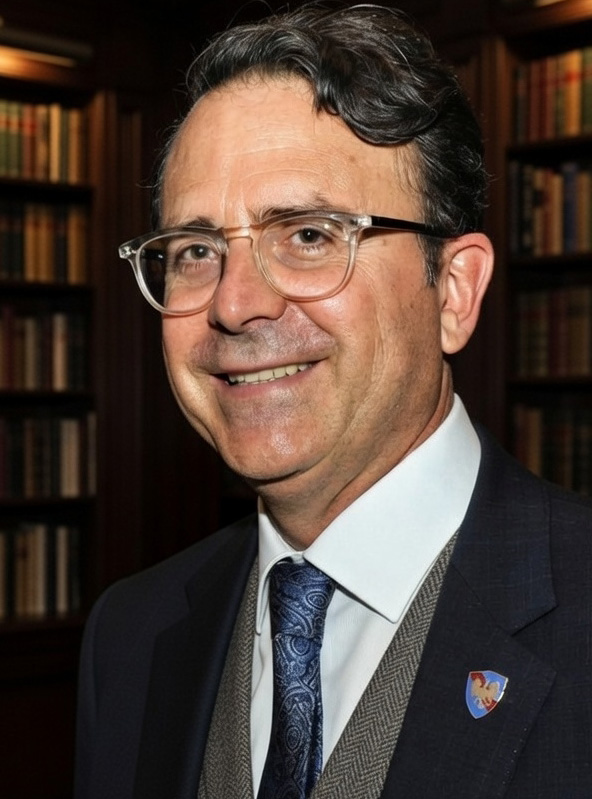
Mr. Michael Rose, Head of School
“Before opening CLASSICAL in 2022, Mr. Rose spent 17 years in education as a middle school, high school, and college instructor. He has taught architecture, grammar, composition, literature, logic, and rhetoric. His academic formation reflects the interdisciplinary spirit of classical education itself. A frequent lecturer and writer, Mr. Rose is the author of The Art of Being Human (Angelico Press, 2023) and The Subversive Art of a Classical Education (Regnery, 2026). His essays and public commentary explore the relationship between beauty, truth, and human flourishing in the face of technological distraction and cultural fragmentation.” Read More