

On Tuesday evening, May 12, Dr. Hartings and I delivered the fourth annual State of the School Address. Each year, this occasion gives me the chance to step back from the urgency of daily school life and account honestly for what we have built, what we have learned, and where we are headed.
The headline number is this: Cincinnati Classical Academy now serves 933 students, drawn from 72 zip codes and 41 school districts across Greater Cincinnati. Families drive from as far as Hillsboro, New Richmond, and Oxford to bring their children to us. Ninety-five percent of our current students are returning next year. Those numbers are not, by themselves, may not be impressive to some. But they are a sign that what we are doing here is reaching people who are hungry for it, and that the hunger is wider than any of us might have assumed when we opened our doors.
This school year marked the first full year of operation across our two permanent campuses. The Summit Park campus opened last August, and the fieldhouse addition came online in March, giving our middle and upper school students a full gymnasium for the first time. Watching our Citadel Life basketball and volleyball tournaments fill that gym with noise and school spirit was one of the more gratifying sights of the year.
At Siebenthaler, as I mentioned last week, Citadel Siena built a new ga-ga pit for the lower school playground. Both campuses are alive in the way a school should be: full, purposeful, and growing into themselves.
The Upper School produced work this year that would honor any school. On the National Latin Exam, eleven students earned Summa Cum Laude Gold Medals, the highest honor available. Among them, freshman Kingston Loehrer earned a perfect score for the second consecutive year. Our ninth graders completed a curriculum ranging from Geometry and Biology to Logic and Rhetoric to Greek and Roman Literature, along with a survey of ancient history spanning more than fifteen hundred years, worked primarily through primary sources.
We inaugurated the Classic Learning Test with the current freshman class, establishing the foundation for our formal college admissions profile, and we hosted our first college representative on campus: The United States Military Academy at West Point.
In the Middle School, two fifth-grade homerooms wrote, cast, and performed plays at recess drawn from their literature curriculum. One class staged Romeo and Juliet; another will perform Tom Sawyer. Sixth grader Isabel Haase won the school spelling bee and advanced to the Greater Cincinnati Regional. Nine students presented at the Ohio State Science Fair, four of them winning monetary awards, and Olivia Moy and Amy Shu earned perfect scores and nominations for the Thermo-Fisher Scientific Innovators Challenge. These are not extracurricular afterthoughts. They are what happens when students are formed by a serious curriculum and then given room to reach.
Our Lower School at Siebenthaler is operating at full capacity, with 496 students filling every classroom. The Wednesday Assemblies continued their role as the heartbeat of Lower School culture, gathering students each week for birthday celebrations, virtue card recognitions, and student talent showcases. Six new teachers joined the Lower School faculty this year and excelled, and all six are returning.
The Sentinel athletic program fielded 595 athletes across fall, winter, and spring seasons this year, competing in thirteen sports from basketball and volleyball to track and field, baseball and softball. Three of our girls volleyball teams won championships. Our boys basketball team produced a championship. And Sara Kappen set a new school record in cross country with a time of 21:38, finishing second at the High School Girls Open.
Beyond athletics, CLASSICAL students participated in Drama Club, Orchestra, Schola Cantorum, CLASSICAL Dance, Chess Club, Art Guild, and more, with extracurricular enrollment totaling well over 600 students across programs. Drama presented two mainstage productions this year, The Arabian Nights and The Miraculous Journey of Edward Tulane.
Our inaugural CLASSICAL Christmas Concert brought every performing ensemble onto a single stage for the first time. Our dance program made its debut with performances of The Nutcracker and Peter and the Wolf. The Orchestra completed its first tour, performing at a local retirement community. These programs are not accessories to a classical education. They are part of what we mean when we say we are forming the whole person.
Citadel Life completed its inaugural year, and by any measure it has already become a genuine cultural institution within the school. Four Citadel Life Days brought students together for competition across athletics, academics, and the arts. Field trips took citadels to the Air Force Museum, the Cincinnati Art Museum, the Cincinnati Zoo, and Hueston Woods.
The Citadel Cup competition is now established, with approximately sixty students serving in leadership and committee roles across the four citadels. The posting ceremony for our sixth graders will take place on the last day of school, welcoming them formally into their citadel families as they prepare for the Upper School. What began as a vision is now a living tradition.
Looking ahead, we will welcome 1,068 students next year across grades K-10, with 427 additional students on grade-level wait lists. The tenth-grade curriculum will include Medieval and Renaissance History, Moral and Political Philosophy, Economics, Chemistry, and Algebra II, along with new electives in Advanced Rhetoric, AP Music Theory, AP Latin, and Shakespeare for the Stage. The school is becoming what it was always designed to be, and the work is, if anything, more urgent and more hopeful than it has ever been.
Thank you for being part of this community. What you are choosing for your children is not the easy path, but it is the right one.
To view the full set of slides from the State of the School Address, click this link.
Torches Up!
Mr. Michael Rose
Headmaster
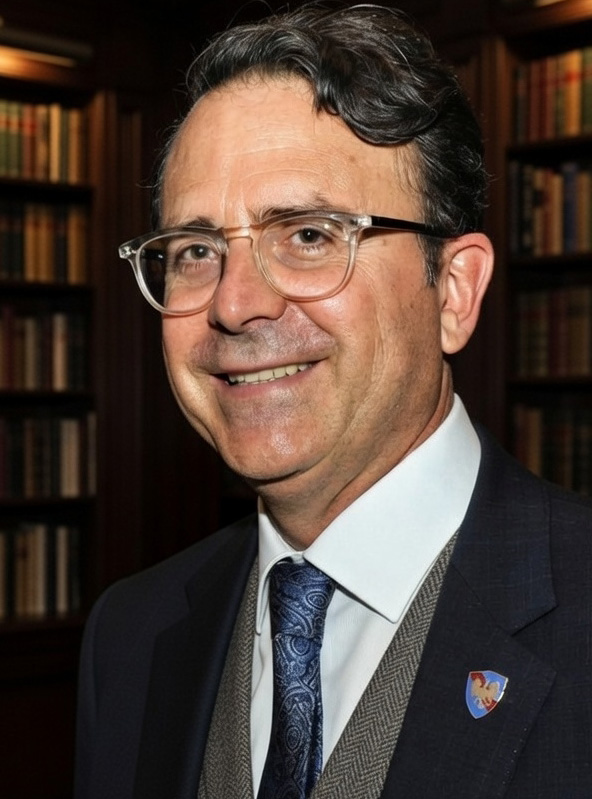
Mr. Michael Rose, Headmaster
Mr. Rose has taught various courses at Brown University, Cincinnati Moeller, and The Summit Country Day School. As a part of his degree work in education, Mr. Rose’s research interests included the Great Books curriculum, the Paideia teaching method, and the “effects of emerging digital technology on student reading, writing, and researching.” Read More