
In the autumn of 1863, the nation was bleeding. Gettysburg had been fought that July, and casualty lists still filled the newspapers of nearly every town in the Union. It was in that season, of all seasons, that President Lincoln issued a proclamation setting apart the last Thursday of November as a national day of Thanksgiving. Americans had kept days of thanks before, by colonial custom and by the occasional presidential decree. At the long urging of Sarah Josepha Hale, Lincoln gave the country a holiday it would keep every year.
His reasoning is worth hearing in his own words. The year, he wrote, had been “filled with the blessings of fruitful fields and healthful skies.” Then he added an observation that applies to every one of us: “To these bounties, which are so constantly enjoyed that we are prone to forget the source from which they come, others have been added, which are of so extraordinary a nature, that they cannot fail to penetrate and soften even the heart which is habitually insensible to the ever watchful providence of Almighty God.”
Prone to forget. Lincoln understood that ingratitude rarely arrives as open rebellion. It creeps in as habit. The blessings that come every day become the blessings no one notices, and a heart that stops noticing slowly hardens. So he asked the whole nation to pause and give thanks “as with one heart and one voice.” He also insisted on humility about the source of those blessings: “No human counsel hath devised nor hath any mortal hand worked out these great things.”
Our students learn that a virtue is a habit, practiced until it becomes second nature. Gratitude is no exception. It must be exercised deliberately, and it grows strongest when it is spoken aloud.
I have written often in these letters of my gratitude for our teachers, and I will never tire of it. This Thanksgiving, I want to turn toward a group of people whose work is harder to see.
Our Assistant Heads, Ms. Lambrecht, Mr. McGrory, and Mr. Johnson, carry a weight that few parents ever glimpse. When a schedule unravels at seven in the morning or a family needs an answer before the end of the day, they are the ones who make the hundred small decisions that leave our teachers free to teach. I owe a special word of thanks to Mrs. Puglielli, whose steady hand guides so much of what happens on both of our campuses each day, from testing and teacher licensure, to state compliance and building and managing two library collections. Much of what families experience as a well-ordered school is the fruit of her quiet labor.
Our deans, Mr. Gibbons, Mrs. Di Nino, and Mr. Giroux, have given themselves to the work that sits at the heart of a classical education: the formation of character. A dean’s day is rarely glamorous. It is spent in hallway conversations and patient corrections, and in long talks with a student who has stumbled and needs to be shown how to rise. Our deans hold students to a high standard because they believe those students can meet it, and they do so with a firmness that never forgets charity. More than one young man and young woman at CLASSICAL has grown into a better citizen and a better human being because a dean took the time.
When I read Lincoln’s line about mortal hands, I think of this team. A school of almost 1,100 students rests on many faithful people doing their work well, day after day, often without a word of thanks. The success CLASSICAL enjoys today belongs to them, and to the many others who have built this school alongside them. CLASSICAL is in strong hands, and I am grateful beyond words to have them at our humble school in Cincinnati.
As you gather around your tables today, I hope you will name aloud the people whose quiet work has blessed your family this year. I leave you with the words of G. K. Chesterton, who understood gratitude as well as anyone: “I would maintain that thanks are the highest form of thought, and that gratitude is happiness doubled by wonder.”
Happy Thanksgiving.
Torches Up!
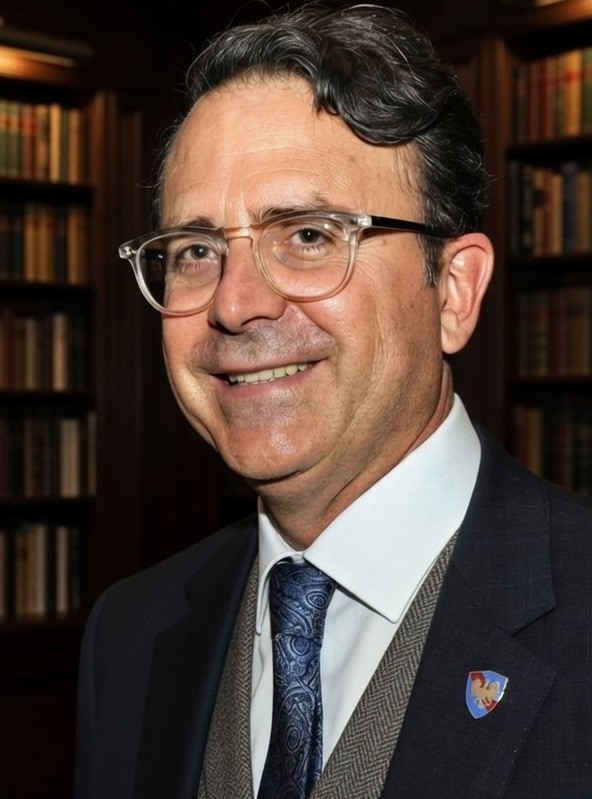
Mr. Michael Rose, Head of School
“Before opening CLASSICAL in 2022, Mr. Rose spent 17 years in education as a middle school, high school, and college instructor. He has taught architecture, grammar, composition, literature, logic, and rhetoric. His academic formation reflects the interdisciplinary spirit of classical education itself. A frequent lecturer and writer, Mr. Rose is the author of The Art of Being Human (Angelico Press, 2023) and The Subversive Art of a Classical Education (Regnery, 2026). His essays and public commentary explore the relationship between beauty, truth, and human flourishing in the face of technological distraction and cultural fragmentation.” Read More