
Every old school was young once. At some point a few people stood around on an ordinary autumn weekend and decided without much ceremony that what they had just done was worth doing again next year. I had the odd feeling this past weekend that CLASSICAL was in the middle of one of those weekends, and I suspect I was not alone in it.
Our word tradition comes from the Latin tradere, meaning “to hand over.” I keep returning to that verb because handing over is most of what a classical school does. Our students read Homer and work through Euclid and conjugate Latin because someone before them thought these things were worth the trouble of keeping. A school that teaches in the classical tradition should have a few traditions of its own, some rhythm to the year that students look forward to and, eventually, come home to.
Friday evening brought our first annual high school homecoming dance, held in the ballroom of the Wyoming Fine Arts Center. The young men wore jackets and ties. The young women were lovely in their homecoming dresses. An architect can’t help noticing rooms, and this one, with its tall windows and old-world grace, asked something of the people in it. Our students answered. They greeted chaperones by name and danced with the joy of kids who know they belong. The courtesy practiced every morning at our classroom doors showed up on a Friday night when nobody required it, and that pleased me more than anything else I saw.
Saturday we held our inaugural Homecoming Bonfire, organized by our Sentinel football team with major assistance from our Parent Volunteer Committee. People have been standing around fires on cool nights for as long as there have been people, and it still works. The Romans kept a flame burning in the temple of Vesta and never let it go out. For them the hearth was the heart of the city. (Our own Torches Up! comes from that same family of images.) My gratitude goes out to all the PVC parents who helped make that evening memorable for the 350 people from the CLASSICAL community in attendance. Their planning and plain hard labor made the night possible.
Sunday we closed with the third annual Classical Cup golf scramble. Three years old makes this event our elder statesman. That tells you something about the age of everything else around here. I have always thought golf a fitting game for a classical school. It asks for patience and honor, and it is one of the few sports in which players call penalties on themselves. A scramble carries its own small lesson. Each foursome plays from its best shot, so a good swing helps the whole team and a bad one is forgotten by the next tee.
I know a homecoming without alumni sounds a little comic. Our first graduating class is still two and a half years off, and nobody has yet “come home” to CLASSICAL in any full sense. But that’s the whole point. G.K. Chesterton called tradition the democracy of the dead, a way of giving our ancestors a vote. A young school has no ancestors. The students in it now will become them. The high schoolers who danced in that ballroom and warmed their hands by that fire are setting customs that children not yet born will inherit and never think twice about, assuming things were always done this way.
Josef Pieper wrote that true festivity is an act of affirmation, a way of saying that the world and our life in it are good. Tradition, when it is healthy, does much the same. Setting time aside to celebrate tells the young what their elders love, and they pay closer attention to that than to anything announced from a podium.
Some October a few years from now, a graduate will come back to campus with a spouse at her side and tell a wide-eyed freshman, by the flickering light of the bonfire, that she was there for the first one. That night, homecoming will finally mean what it says. The first stones went down this past weekend, and I am grateful to every family who helped lay them.
Torches Up!
Mr. Rose
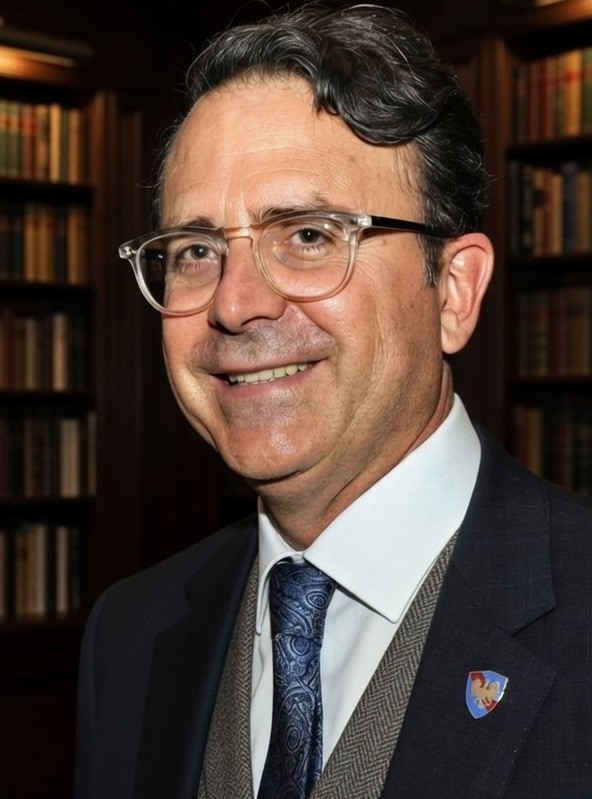
Mr. Michael Rose, Head of School
“Before opening CLASSICAL in 2022, Mr. Rose spent 17 years in education as a middle school, high school, and college instructor. He has taught architecture, grammar, composition, literature, logic, and rhetoric. His academic formation reflects the interdisciplinary spirit of classical education itself. A frequent lecturer and writer, Mr. Rose is the author of The Art of Being Human (Angelico Press, 2023) and The Subversive Art of a Classical Education (Regnery, 2026). His essays and public commentary explore the relationship between beauty, truth, and human flourishing in the face of technological distraction and cultural fragmentation.” Read More