

A generation that learns to prompt a machine before it learns the subject will inherit the tool and lose the craft. Dr. Jacob Imam of the College of St. Joseph the Worker spoke to our community recently on AI and the future of work.
On Wednesday evening, more than 200 members of the CLASSICAL community gathered for the first Veritatis Splendor talk of the year. Our guest was Dr. Jacob Imam, founder and President of the College of St. Joseph the Worker in Steubenville. His subject could hardly have been more timely: artificial intelligence and the future of work. I left the room convinced that every parent in our school should hear the argument he made, and so I want to share the heart of it here.
Dr. Imam leads one of the most interesting experiments in American higher education. The College of St. Joseph the Worker welcomed its first students in the fall of 2024. Every student earns a Bachelor of Arts in humanities while also training in a skilled trade under master craftsmen. A young man may spend his morning with Augustine and his afternoon at a workbench on a job site. Students serve as apprentices, restoring the old buildings of a struggling river town and using their wages to pay for their education. Dr. Imam describes the whole enterprise as an attempt to call the bluff on the long divorce between the head and the hands, and the college crest says as much with a hammer set beside a lily.
He began the evening with a definition. Drawing on Aquinas, he described “work” as purposeful activity by which a person gives a genuine good to others, participates in the common good, and is himself formed through the activity.
Then he told a story. In the early years of the twentieth century, America’s woodworkers were among the finest craftsmen of their age. They had learned their trade by hand over long apprenticeships, and they knew the grain of oak and walnut the way a farmer knows the weather. Around 1910, these same men began to bring machines into their shops. The machines served them well. A carpenter who already understood joinery could use a powered saw to cut faster and cleaner, and his knowledge governed the tool at every stage. Then that generation died. Their successors inherited the machines without inheriting the knowledge. They knew how to operate the equipment, yet they no longer knew the craft the equipment had been built to serve. The machines did the work, and the men who tended them were no longer craftsmen.
Dr. Imam asked his audience to see themselves in that story. Today’s AI tools can be remarkably useful in the hands of someone who has true mastery of a field. A seasoned attorney who has spent decades with the law can use these new tools the way the old carpenter used his saw, with judgment presiding over the machine. That generation of knowledgeable workers will pass, as the woodworkers passed. If the generation behind them learns to prompt a machine before it learns the subject itself, it will inherit the tool and lose the craft. The output may look similar for a while. The results will not be the same, and neither will the people producing them.
This brought him to the claim at the center of the night. Work and a job, he insisted, are two different things. A job is an arrangement for earning a living. Work is something the human person needs in order to become fully human, and it takes both active and contemplative forms. The hand shaping a chair and the mind dwelling on a proof of Euclid are both at work, and both are being formed by the effort. A tool that removes the effort entirely also removes the thing that was forming the worker.
That’s why our students still diagram sentences and draft their essays by hand. I am in no hurry to give them a machine that will do their thinking for them before they have learned to think. The day will come when they use AI tools well, and they will use them well precisely because they first did the work without them.
Earlier in the day, Dr. Imam also spoke with our freshman and sophomore classes as part of our College & Career Readiness program. It is a rare gift for students of that age to hear a college president speak seriously about work and vocation at the very moment they are beginning to imagine their own futures. I am grateful to Mrs. Schmidt and the Office of College & Career Readiness for making that conversation possible.
The woodworkers of 1910 could not have known what would be lost when they were gone. Our children have the advantage of their example. The charge of this school is to make sure the next generation inherits the craft along with the tools.
Torches Up!
Mr. Rose
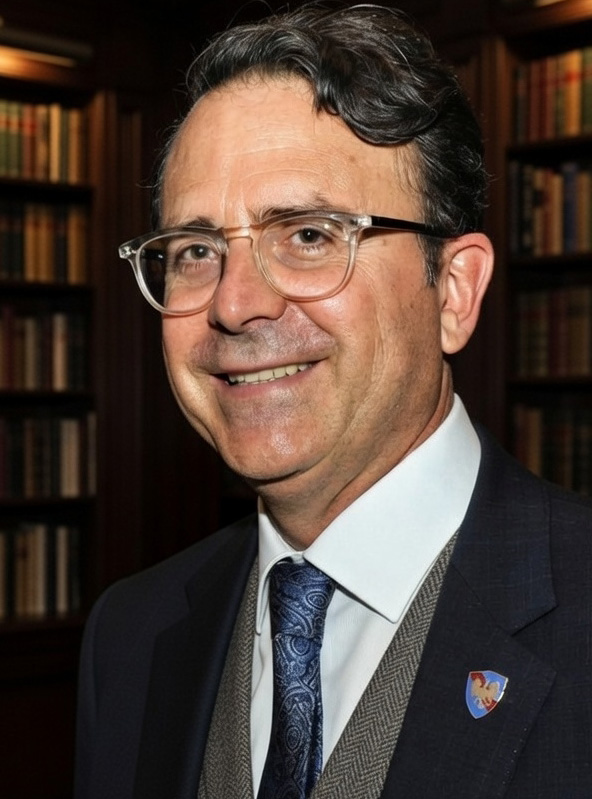
Mr. Michael Rose, Head of School
“Before opening CLASSICAL in 2022, Mr. Rose spent 17 years in education as a middle school, high school, and college instructor. He has taught architecture, grammar, composition, literature, logic, and rhetoric. His academic formation reflects the interdisciplinary spirit of classical education itself. A frequent lecturer and writer, Mr. Rose is the author of The Art of Being Human (Angelico Press, 2023) and The Subversive Art of a Classical Education (Regnery, 2026). His essays and public commentary explore the relationship between beauty, truth, and human flourishing in the face of technological distraction and cultural fragmentation.” Read More