

We are living through an era of extraordinary knowledge and extraordinary confusion. Human beings have never known more about the material world, and yet we seem increasingly unable to answer the questions that matter most. Part of the reason is this: the questions that most urgently need answering cannot be answered from within any single academic or practical discipline. They are questions that sit at the intersection of many fields, and they require a mind that has ranged widely enough to hold those fields in conversation with one another.
Consider the question that perhaps defines our cultural moment: what is artificial intelligence doing to human cognition? It sounds, at first, like a technical problem, something to be handled by engineers and computer scientists. But no answer worth having can be assembled from computer science alone.
You need philosophy of mind to ask what cognition even is, what it means for a process to be genuinely mental rather than a sophisticated simulation of mentality. You need theology to ask whether the soul is reducible to information processing, and whether something is lost when memory, judgment, and attention are outsourced to machines.
You need the history of technology to understand how previous revolutions in information, the printing press, the telegraph, the photograph, reshaped human perception and social life, so that we are not perpetually astonished by what should be recognizable.
You need literary criticism because literature is one of the great instruments we have developed for understanding what it feels like to be a human being, and a world in which reading is displaced by scrolling is a world that has given something up.
To answer the question well, you need all of these, held together in a single mind, worked on simultaneously, not sequentially. That is not the profile of a specialist. It is the profile of a classically educated person.
What I am describing is a diagnosis of an abdication. The fragmentation of knowledge into ever-narrower disciplines has produced extraordinary technical power, and we should not pretend otherwise. But it has also produced a kind of collective intellectual helplessness in the face of the questions that matter most, because those questions are precisely the ones that do not respect disciplinary boundaries. By nature, they require synthesis. And synthesis, the difficult, patient work of holding many things in mind at once and drawing them into coherent relationship, is exactly what a classical education forms the student to do.
At Cincinnati Classical Academy, we do not teach subjects in isolation from one another. We teach history and literature as a conversation, so that a student reading Homer also understands the world that produced Homer, and can hear the echoes of Homer in Virgil, and can trace how that epic tradition shaped the way Jefferson thought about liberty and sacrifice. We teach mathematics and music together, as the ancients did, because both are forms of ordered proportion and both teach the mind to recognize structure. We teach Latin as a lens through which English grammar, Roman law, religious liturgy, and the Declaration of Independence all become more legible at once. We ask students to draw classical architecture by hand because the hand teaches what the eye alone cannot see: the inner logic of a proportional system.
The world will go on producing narrow experts. It will go on producing algorithms that can retrieve anything and understand nothing. What it will not produce, except by sustained and deliberate effort, is the kind of mind that can look at a genuinely novel crisis and bring to bear everything that the human tradition has learned about being human.
And here is what the classical tradition has always understood, which our moment seems to have forgotten: there is no contradiction between being a classically educated person and becoming a specialist afterward. The physician who has read Homer and studied Aquinas and learned to argue from first principles brings something to his patients that his equally credentialed colleague, trained only in the protocols of medicine, does not. The engineer who understands the history of technology and has thought seriously about what human flourishing requires is a different kind of engineer, and a better one.
The classical education does not preclude depth. It precedes it, and it governs it. That is what we are building here. It is slow work, and it is difficult work, and it is the only work that is fully adequate to the moment we are in.
Torches Up!
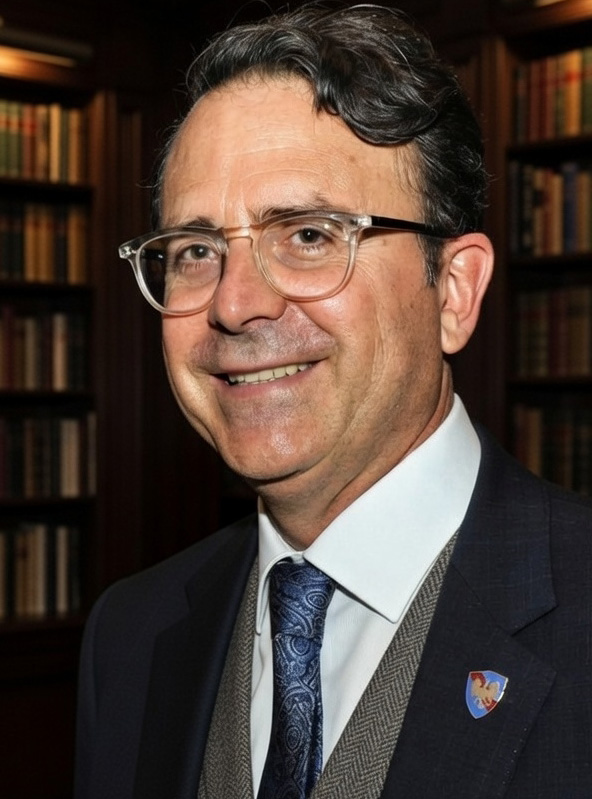
Mr. Michael Rose, Headmaster
Mr. Rose has taught various courses at Brown University, Cincinnati Moeller, and The Summit Country Day School. As a part of his degree work in education, Mr. Rose’s research interests included the Great Books curriculum, the Paideia teaching method, and the “effects of emerging digital technology on student reading, writing, and researching.” Read More