

On Tuesday evening, CLASSICAL hosted the latest Veritatis Splendor talk in our Summit Park campus’s symposium room. Originally, we had scheduled classical architect James McCrery to present on the subject of classical architecture. Because Mr. McCrey’s schedule changed and could not be with us, I stepped in to provide an overview of a related course I taught last semester in our upper school, Introduction to Classical Architecture, as well as the design competition that grew out of it. What happened in that classroom, and what came of it, strikes me as worth sharing with every CLASSICAL family.
The course began where Western architectural thought begins: with the Roman architect Vitruvius, who in the first century BC wrote the only complete architectural treatise to survive from classical antiquity. Vitruvius opens by describing the ideal education for an architect, and the list is striking: the architect must be literate, versed in history, schooled in philosophy, knowledgeable about music, astronomy, medicine, and law. He is describing, in other words, a classical liberal arts education. Architecture, for Vitruvius, is the fruit of a fully formed human being, someone who has learned to see the patterns that govern the world and can give them ordered, beautiful form in the built environment.
Central to Vitruvius’s understanding of beauty is the conviction that it arises from the natural world and above all from the human person. The Greeks, for example, derived their units of measure directly from the body: the foot, the cubit, the span of the hand, etc. And just as the human form possesses a legible, proportional order, so too must a building. When those relationships are rightly observed, beauty emerges and can be recognized by anyone because we ourselves are ordered beings. We recognize proportion in the built world because it is already written into our own bodies and into the order of nature.
My ninth graders also encountered these principles through their hands. A significant portion of the course was devoted to drawing — tracing first, to build visual memory and manual skill, and then observation drawing, proportioning by eye and confirming by measurement. Vitruvius was clear that the architect must be skilled in draftsmanship because drawing is thinking made visible. When a student traces a classical column, the hand inhabits the logic of the form, and the eye begins to develop what we might call “proportional judgment,” the capacity to sense whether a thing is rightly made.
All of this led to the culminating project of the semester: the Summit Park Monument Design Competition. Students were challenged to design a monument for the grassy knoll at the end of Anderson Way, where our flagpole currently stands in the foreground of the school building. The site is one parents pass every time they come to campus, and we genuinely want to enhance it with classical architecture worthy of our mission. The designs had to employ one of the classical orders, demonstrate proper proportional relationships, and be feasible within a realistic budget. This was real work for a real site, and the students treated it accordingly.
All student models and drawings were exhibited in the Summit Park library on Tuesday, and we were gratified by the quality and seriousness on display. Those who attended Tuesday evening’s event had the opportunity to view the exhibition before the presentation. Selections from this body of work will also appear in the Spring Art Show in May, and we invite every CLASSICAL family to come and see what this course produced.
To select the winning design, we assembled a jury of 35 faculty and staff members, who evaluated all entries anonymously against criteria drawn from the semester’s study: faithfulness to classical principles, beauty and visual harmony, structural soundness, clarity of purpose, appropriateness to the site and the school’s mission, and practical feasibility. Five designs emerged as finalists, and we are proud to recognize each of them.
Fifth place: Vincent Peck
Fourth place: Anna Reed
Third place: Veronica Kraft
Second place: Anna Mendoza
First place: Kingston Loehrer
Congratulations to all!
Kingston’s design will now be presented to our Board of Directors for serious consideration as a potential addition to our campus. We cannot guarantee it will be built. That depends on factors beyond the course, but it will be reviewed with real intention, and that alone is a remarkable achievement for a high school freshman.
My students this semester became heirs to a tradition stretching from the architects of the Parthenon through Vitruvius and Jefferson to the present day. They learned that they are not condemned to the architectural poverty of our age, that they can reach back, grasp that golden thread of tradition, and pull it forward into the present. That is what education in the classical tradition is all about: joining the Great Conversation and passing it on.
Torches Up!
Mr. Rose
Headmaster
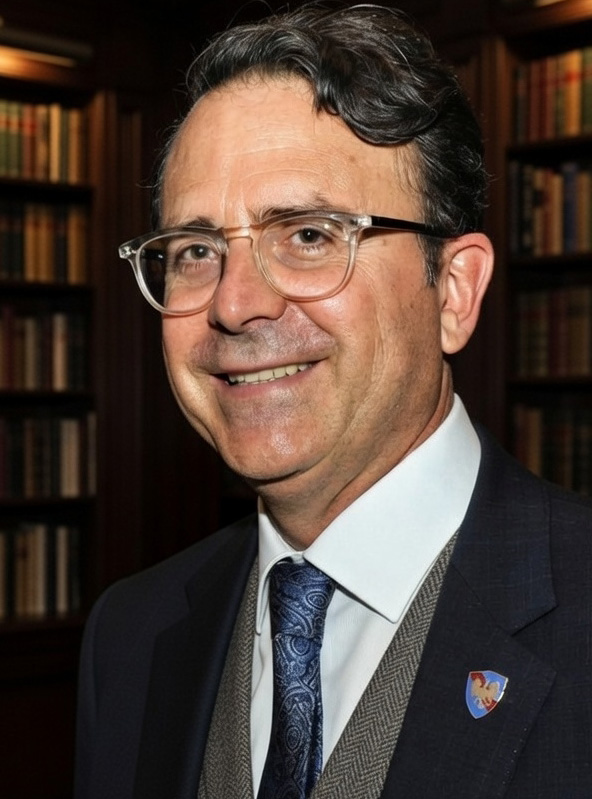
Mr. Michael Rose, Headmaster
Mr. Rose has taught various courses at Brown University, Cincinnati Moeller, and The Summit Country Day School. As a part of his degree work in education, Mr. Rose’s research interests included the Great Books curriculum, the Paideia teaching method, and the “effects of emerging digital technology on student reading, writing, and researching.” Read More