

This past Monday, our faculty gathered for a full day of professional development. I want to share something of what we explored together, because the ideas at the center of our conversation go directly to the heart of what Cincinnati Classical Academy is trying to build—and why.
The theme of the day was simple, but not soft: strength rejoices in the challenge.
We began by taking an honest look at the world our students are growing up in. We live in a moment that treats difficulty as a design flaw. The instinct of our age—in parenting, in education, and in culture broadly—is to smooth the path and protect young people from struggle. That instinct is often motivated by love. But it is mistaken.
The elimination of difficulty does not produce human flourishing. It produces human fragility.
Students who have never been asked to read and analyze a genuinely demanding text cannot think through complex ideas. Students who have never been required to revise an essay five times do not develop the stamina to revise their lives. Students who have never been held accountable for laziness or half-hearted effort do not develop the internal resources to hold themselves accountable later. When we clear every obstacle from a child’s path, we do not prepare him for the road ahead. We leave him unready for it.
At CLASSICAL, we do something different—and deliberately so.
We spent much of the morning with great writers from our own curriculum: C.S. Lewis, Willa Cather, and Fyodor Dostoevsky. From Lewis we considered The Abolition of Man, where he warns of an education that trains the intellect while shrinking the soul. From Cather’s My Ántonia, we saw the quiet heroism of endurance on the prairie—the long fidelity required to cultivate land, family, and culture. From Dostoevsky’s Crime and Punishment, we confronted the moral and spiritual consequences of evading responsibility, and the painful but redemptive path of confession and suffering rightly borne.
These authors differ in nationality, temperament, and century. Yet they converge on a single truth: difficulty is not the enemy of the good life. It is one of the primary conditions for it.
The most enduring figures in our literary tradition are not those who were shielded from hardship. They are the ones who met hardship honestly and were made greater by it. Again and again, across very different stories and very different centuries, the pattern is the same: joy is not the reward for comfort. It is the fruit of fidelity. It comes from staying the course when staying the course is costly.
We also reflected on heroes from history—men and women who endured imprisonment, exile, public failure, or material poverty. Their greatness was not found in spite of the pressure they endured. It was formed because of it. Suffering, rightly met, does not disqualify a person from a life of meaning and service. It prepares him for it.
This distinction gets at something essential about what we are doing at Cincinnati Classical Academy.
Our culture at large has grown accustomed to asking, “How does this make me feel?” Classical education asks a different question: “What does this make me?”
The goal is not to feel safe at every moment. The goal is to become safe for others—to become the kind of person who can be trusted and relied upon; who can endure difficulty without being destroyed by it; who can serve others without needing applause for it. That kind of character is not produced by ease. It is formed through rightly ordered challenge, held inside a community of genuine care and high expectation.
This is why we assign demanding texts. It is why we insist on careful grammar and precise mathematical reasoning. It is why we expect students to memorize poetry, to defend their ideas in discussion, and to revise their writing. It is why we correct them when they are careless and commend them when they persevere.
We are not interested in making school artificially hard. But we are deeply committed to making it meaningfully hard.
Because we have seen what happens when young people are trusted with real responsibility. We have seen seventh graders who once feared public speaking grow into confident orators. We have seen reluctant readers become attentive thinkers. We have seen students discover that the moment they most wanted to quit was the moment just before growth.
This is not accidental. It is the fruit of a faculty that believes challenge is an expression of respect. To lower standards is, in a subtle way, to communicate that we do not believe a child can rise to them. To maintain high standards—and to walk patiently alongside students as they strive to meet them—is to communicate the opposite: We believe you are capable of more.
Our faculty left Monday renewed and recommitted to this work. We are grateful to labor in a community of parents who understand that education is not just about college readiness or résumé building, but about the formation of the whole person—mind, body, and heart.
And when your son or daughter comes home and tells you that something was hard today, we hope you will consider saying: “Good. That is exactly why it is worth doing.”
Torches Up!
Mr. Rose
Mr. Rose
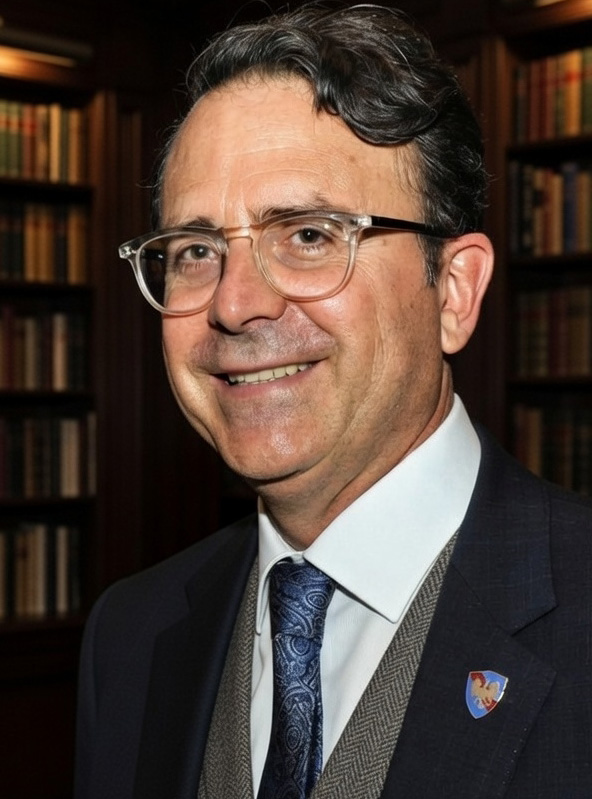
Mr. Michael Rose, Headmaster
Mr. Rose has taught various courses at Brown University, Cincinnati Moeller, and The Summit Country Day School. As a part of his degree work in education, Mr. Rose’s research interests included the Great Books curriculum, the Paideia teaching method, and the “effects of emerging digital technology on student reading, writing, and researching.” Read More