

This year, for the first time, Cincinnati Classical Academy has a School Profile to send to college admissions offices. Our oldest students will be going into tenth grade next year, and our first graduating class will walk across a stage in 2029, which means we have not yet had occasion to introduce ourselves to the world of college admissions.
That introduction begins now. The profile does what a school profile is supposed to do: it describes who we are, what our students study, and how we evaluate their work. But it does something more than that, and I want to take a moment to tell you about it, because the story it tells is your children’s story too.
A college admissions officer reading our profile for the first time encounters something that does not fit easily into the standard categories. We are a tuition-free public community school that requires Latin of every student through at least tenth grade. We draw students from seventy-two zip codes across six counties, yet our curriculum is built around Homer and Dante and Dostoevsky read in their entirety. Our high school students write extensive essays, defend arguments in Socratic discussion, compose a Senior Thesis in their final year, and stand before a faculty panel to defend it publicly. We do not offer AP courses in history, literature, or philosophy—not because we find those subjects insufficiently rigorous, but because our courses in those areas surpass what the AP framework asks of students. We say that plainly in the profile, and we mean it.
The profile explains our approach to Advanced Placement honestly, and I think that honesty matters enormously for our students. There is real pressure in the college admissions landscape to accumulate AP credits like currency, and schools that resist that pressure can appear, to the uninitiated eye, to be offering something thinner. The truth is precisely the opposite. When our juniors read and discuss the whole of Tocqueville’s Democracy in America rather than preparing for a standardized rubric, they are doing harder intellectual work, not easier. The profile makes that case directly, and it gives admissions officers a framework for reading our students’ transcripts with understanding rather than confusion.
What the profile also communicates, I hope, is the coherence of what we have built. A student who has moved through our program from seventh grade onward (or earlier) has encountered a curriculum that does not fragment into disconnected electives but builds, year by year, toward genuine formation. The Senior Thesis is not a capstone bolted onto an otherwise conventional high school experience. It is the natural conclusion of years of learning to read carefully, think precisely, and speak honestly about things that matter. When a CLASSICAL graduate sits across from an admissions officer and discusses her thesis, she is not performing. She has actually done the work.
We are proud of this document. I believe it accurately represents our program with the clarity and confidence it deserves. It is available on our website, and we encourage you to read it.
There is a line near the end of the profile, addressed to admissions officers, that I would like to highlight: “We are confident that the comparison will speak for itself.” That confidence is not bravado. It rests on what your students have actually done, and on the school we have actually built together. The profile is how we introduce that school to the wider world. We think it is an introduction worth reading.
Torches Up!
Mr. Rose
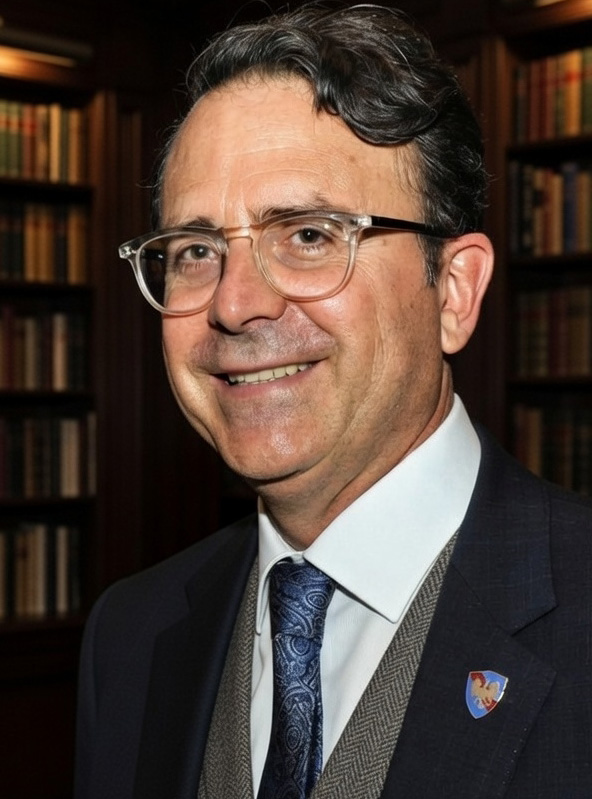
Mr. Michael Rose, Headmaster
Mr. Rose has taught various courses at Brown University, Cincinnati Moeller, and The Summit Country Day School. As a part of his degree work in education, Mr. Rose’s research interests included the Great Books curriculum, the Paideia teaching method, and the “effects of emerging digital technology on student reading, writing, and researching.” Read More