Last Saturday evening, nearly 500 friends of Cincinnati Classical Academy gathered downtown in the Hall of Mirrors for the third annual Classical Renaissance Gala. I am grateful to each of you who were there. For those who couldn’t make it, I want to share something of what was said because the theme of the evening was one I believe goes to the heart of why this school exists.
My talk was titled “Leading While the World Is on Fire,” and the fire in question is not difficult to name. We live in a society of extraordinary technological power and, in certain respects, extraordinary shallowness. Algorithms now shape attention. Outrage travels faster than truth. Young people are trained — slowly, imperceptibly, by the devices in their pockets — to respond rather than to think. The less they know and the less they are able to reason, the more easily they are shaped into what someone else wants them to be: thoughtless consumers, tribal partisans, and anxious spectators of their own lives.
Against this backdrop, what Cincinnati Classical Academy does is genuinely countercultural: we hold a fundamentally different view of what education is for.
The dominant view, the one that drives most of what passes for educational reform today, treats the human mind as an apparatus to be tuned for maximum efficiency. It speaks of skills and competencies, of data-driven outcomes and personalized learning pathways. It asks, always, what a student will be able to do. It rarely asks what a student will be able to love, to understand, or to withstand. It produces, in C.S. Lewis’s phrase, “men without chests” — people trained to be clever and efficient, but lacking the moral core to govern themselves.
At CLASSICAL, we believe something different. We believe that education is not job preparation. It is not skills acquisition. It is not optimization. Education, properly understood, is the formation of a human being. And that formation takes place through encounter with the true, the good, and the beautiful and through the hard, slow, irreplaceable work of reading difficult books, learning rigorous grammar, memorizing great poems, studying the arc of Western art and music and philosophy, and being asked, repeatedly, to think clearly and speak honestly.
There is a name for this kind of education. It’s called classical liberalism — and the word liberal here comes from the Latin liber: free. A liberal education is an education suited for free people. It liberates. But from what?
Certainly from ignorance. But ignorance is not the only threat to freedom, and perhaps not the most dangerous one in our moment. The deeper threat is manipulation — the condition of a person who does not know enough, or think well enough, or love the right things enough, to resist being shaped entirely by external forces. The antidote has always been the same: an education that forms character on the foundations of truth, beauty, and virtue. An education that gives students something to stand on.
This is why we teach students to write by hand and to diagram sentences. Why we require memorization of poetry. Why we teach Latin, study Euclid, read Homer and Shakespeare and Lincoln as living voices rather than historical curiosities. Why our students recite, debate, and are expected to speak in full sentences about difficult things. We are doing these things, as I said Saturday evening, because they produce the kind of person who can think, who can lead, and who can remain unflappable when the world around them grows chaotic.
The painting I described that night — Hieronymus Bosch’s Torment of St. Anthony the Abbot, which hangs in my conference room — shows a saint kneeling at the center of absolute chaos, two fingers raised (like our Torches Up!), perfectly centered while demons swarm and a city burns in the background. That image has become for me a quiet emblem of what we are trying to do here. We don’t deny the chaos. Nor do we flee from it. Rather, we form young people who are rooted deeply enough to remain standing in the middle of it.
Those young people are the whole point. And no one made that clearer on Saturday evening than Nektarios Haralambos, a fourth grader who stood before an intimidating crowd of adults in the Hall of Mirrors and told them, in his own words, why he loves being a CLASSICAL student. Nektarios is a young man who has already begun to understand what he has been given. The room was very quiet while he spoke, and he received a well-deserved standing ovation. He was the star of the evening!
We also heard from another star: Mrs. Gleason, our lead kindergarten teacher, who spoke about her family’s journey to CLASSICAL with honesty and warmth. A teacher who can speak that way — from the inside of the experience, from genuine belief in the mission — is a reminder of what a school actually is. It is not a building or a curriculum. It is a community of people who share a serious conviction about what children deserve.
That conviction is what the Gala celebrates. You are part of a community that has chosen, against considerable cultural pressure, to believe that depth matters more than convenience, that formation matters more than performance, that what a child loves and understands and can endure matters more than any score on any test. That is not a small thing to choose. And it is not a choice that sustains itself without support.
Thank you for raising children who remind the rest of us why it is worth doing.
Torches Up!
Mr. Rose
Headmaster
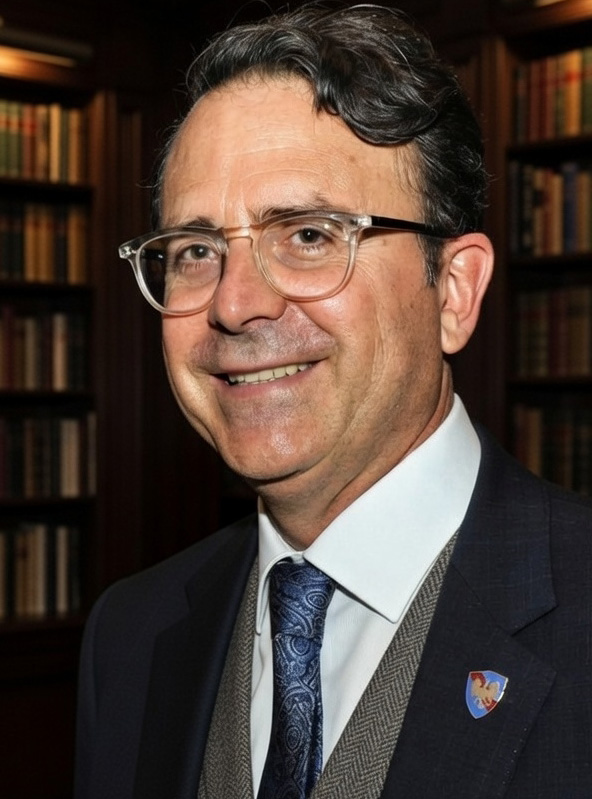
Mr. Michael Rose, Headmaster
Mr. Rose has taught various courses at Brown University, Cincinnati Moeller, and The Summit Country Day School. As a part of his degree work in education, Mr. Rose’s research interests included the Great Books curriculum, the Paideia teaching method, and the “effects of emerging digital technology on student reading, writing, and researching.” Read More